

How Free Bets Work: Understanding UK Bookmaker Offers
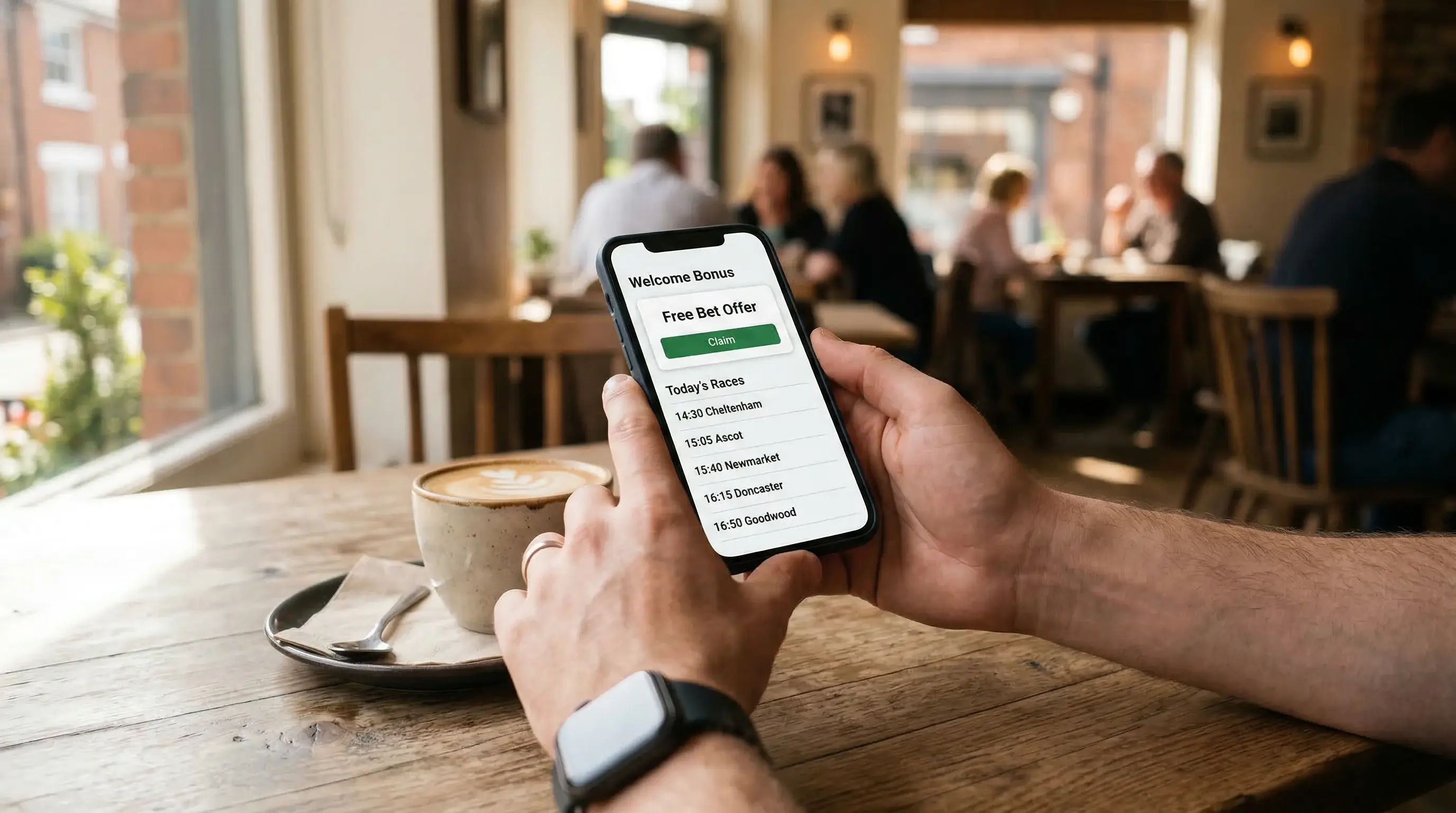
A free bet is essentially a promotional token issued by a bookmaker that allows you to place a wager without using your own money. Win, and you keep the profit. Lose, and you've risked nothing beyond whatever qualifying bet was required to unlock the offer. Sounds simple enough, but the details determine whether an offer is genuinely valuable or merely clever marketing.
The Qualifying Bet
Almost every free bet offer requires you to place a qualifying bet first. This is the mechanism bookmakers use to ensure you're an active customer, not someone simply grabbing free money and disappearing. A typical structure looks like this: deposit £10, place a £10 bet on a selection at minimum odds of 1/2 (1.50), and receive £30 in free bets once your qualifying bet settles.
The minimum odds requirement is crucial. Bookmakers set this threshold to prevent people from placing extremely safe bets at odds like 1/100 just to trigger the free bet. Most offers require odds of at least 1/2, though some stipulate evens (2.0) or higher. Check this before placing your qualifying bet, because a bet at odds below the threshold won't count.
Stake Not Returned
Stake Not Returned (SNR) means your free bet stake isn't included in any winnings. If you place a £10 free bet at odds of 4/1 and win, you receive £40 profit rather than the £50 you'd get from a regular cash bet. This single condition typically reduces a free bet's value by 20-30% compared to real money.
Stake not returned is the standard condition on virtually all UK free bet offers. It means exactly what it sounds like: when you win a free bet, you get the winnings but not the original stake. A £20 free bet at 3/1 returns £60, not £80. This distinction matters enormously when calculating expected value and explains why a £30 free bet isn't actually worth £30.
Why Bookmakers Offer Free Bets
Free bets aren't charity. They're customer acquisition tools in an increasingly competitive market. The economics work because bookmakers retain most customers who sign up for welcome offers, generating long-term revenue that exceeds the initial promotional cost.
Recent market pressures have made these offers more generous. According to the HBLB Annual Report 2024-25, average turnover per race fell by approximately 8% in 2024/25 compared to the previous year, representing a 19% decline from 2021/22 levels. This sustained drop in betting activity has pushed bookmakers to compete harder for every customer.
"This positive news cannot hide that the amounts bet on British horseracing continue to fall, posing a challenge to the sustainability of this level of Levy income." — Anne Lambert CMG, Interim Chair, Horserace Betting Levy Board
That challenge for the industry translates into opportunity for bettors. When bookmakers need customers, promotional terms tend to improve. The current environment, with its combination of regulatory pressure and market contraction, has created some of the most competitive free bet offers in years.
Wagering Requirements and Restrictions
Beyond stake not returned, free bets often come with additional conditions. Common restrictions include:
- Expiry periods: Most free bets must be used within 7 days of being credited. Some offers give you 30 days; others demand action within 48 hours.
- Market restrictions: Certain offers exclude specific bet types. Horse racing free bets might not be usable on ante-post markets or Tote bets.
- One per customer: Welcome offers are strictly limited to one per person, per household, per IP address. Bookmakers are aggressive about enforcing this rule and will void winnings from duplicate accounts.
- Payment method exclusions: Deposits made via e-wallets like Skrill or Neteller often don't qualify for welcome offers. Card deposits are almost always required.
The gross gambling yield from remote horse racing betting reached £766.7 million in 2024/25, according to Gambling Commission statistics. That figure represents what bookmakers retained after paying out winnings. Free bet offers are essentially a marketing expense against this revenue, which is why the conditions are carefully structured to protect bookmaker margins while still appearing attractive to customers.
Calculating Real Value
A free bet's real value depends on how you use it. At a basic level, a stake-not-returned free bet is worth approximately 70-80% of its face value when placed on selections at typical odds. Place a £10 free bet on a 4/1 shot with a 20% implied probability, and your expected return is around £8. That's still £8 more than you had, but it's not the full £10 advertised.
For those willing to use matched betting techniques, which we'll discuss later, free bet conversion rates typically reach 75-85% of face value. A £30 free bet can reliably produce £22-25 in extractable profit. This isn't guaranteed money, but it's considerably better than random betting where the house edge works against you.
Top Horse Racing Betting Offers Compared
Welcome offers change frequently, so rather than listing specific promotions that might be outdated by the time you read this, we've focused on what matters: the structural features that determine whether an offer is genuinely valuable. Below is our analysis of the major UK bookmakers and what their typical horse racing offers include.
What to Look For in a Welcome Offer
Before comparing individual bookmakers, understand the hierarchy of value. The best offers share certain characteristics:
- Low minimum odds: Offers requiring bets at 1/2 (1.50) are more flexible than those demanding evens or higher. Lower thresholds mean safer qualifying bets.
- Single turnover requirement: The qualifying bet settles once, you get your free bets. Avoid offers requiring multiple turnovers, where you must wager bonus funds several times before withdrawal.
- Reasonable expiry: Seven days is standard and manageable. Anything less than 72 hours creates unnecessary pressure.
- Best Odds Guaranteed included: A welcome offer combined with BOG protection gives you flexibility on when to take prices.
Major Bookmaker Comparison
| Bookmaker | Typical Offer Structure | Min Odds | BOG Available | Live Streaming | Notable Features |
|---|---|---|---|---|---|
| bet365 | Bet Credits format | 1/5 (1.20) | Yes (from 8:00) | Yes (funded account) | ITV Racing price match from 10:00 |
| Paddy Power | Money back as cash | Evens (2.0) | Yes (from 8:00) | Yes | Money back specials on selected races |
| Ladbrokes | Free bets | 1/2 (1.50) | Yes (from 8:00) | Yes | Established high street presence |
| Coral | Free bets | 1/2 (1.50) | Yes (from 8:00) | Yes | Coral Connect card integration |
| Sky Bet | Free bets | 1/2 (1.50) | Yes (from 9:00) | Yes (Sky Sports Racing) | £50,000 daily BOG limit |
| Betfair Sportsbook | Free bets | 1/2 (1.50) | Limited | Yes | Exchange betting available |
| William Hill | Free bets | 1/2 (1.50) | No | Yes | Major high street brand |
| Betway | Free bets | 1.75 | Yes (from 9:00) | Yes | Competitive horse racing focus |
| BoyleSports | Free bets | Evens (2.0) | Yes (from 8:00) | Yes | Strong Irish racing coverage |
| BetVictor | Free bets | Evens (2.0) | Yes (from 9:00) | Yes | Price Promise feature |
The bet365 Approach
bet365's structure differs from most competitors. Rather than free bets, they offer Bet Credits which function similarly but come with their own terms. The low minimum odds requirement of 1/5 makes qualifying straightforward. Their ITV Racing price match, active from 10:00 on race days, guarantees the best price offered by six major competitors on televised races, adding ongoing value beyond the welcome bonus.
Sky Bet's BOG Advantage
Sky Bet's standout feature isn't the welcome offer itself but the accompanying Best Odds Guaranteed limit. At £50,000 daily, it's among the highest in the industry. Their integration with Sky Sports Racing also provides quality live streaming for watching your bets land.
The William Hill Consideration
William Hill remains a major brand but no longer offers Best Odds Guaranteed on horse racing. This is unusual among top-tier bookmakers and represents a genuine disadvantage. If you regularly take early prices that drift, this omission costs money over time. Their welcome offer would need to be substantially better than competitors to compensate.
Choosing Based on Betting Style
The best offer depends on how you bet. If you primarily bet on televised racing, bet365's price match adds ongoing value. If you prefer Irish racing, BoyleSports' coverage might matter more than a slightly larger offer elsewhere. If you bet significant amounts, Sky Bet's high BOG limit becomes relevant. Don't chase the biggest headline number. A £50 free bet with restrictive conditions may be worth less than a £30 offer from a bookmaker with generous ongoing features.
Best Odds Guaranteed: What It Means and Why It Matters
Best Odds Guaranteed is one of the most valuable features a bookmaker can offer for horse racing, yet many bettors either don't understand it or fail to use it strategically. The concept is straightforward: if you take a price on a horse and the starting price (SP) is higher, the bookmaker pays you at the better odds. If the SP is lower, you keep your original price. You can't lose.
How BOG Works in Practice
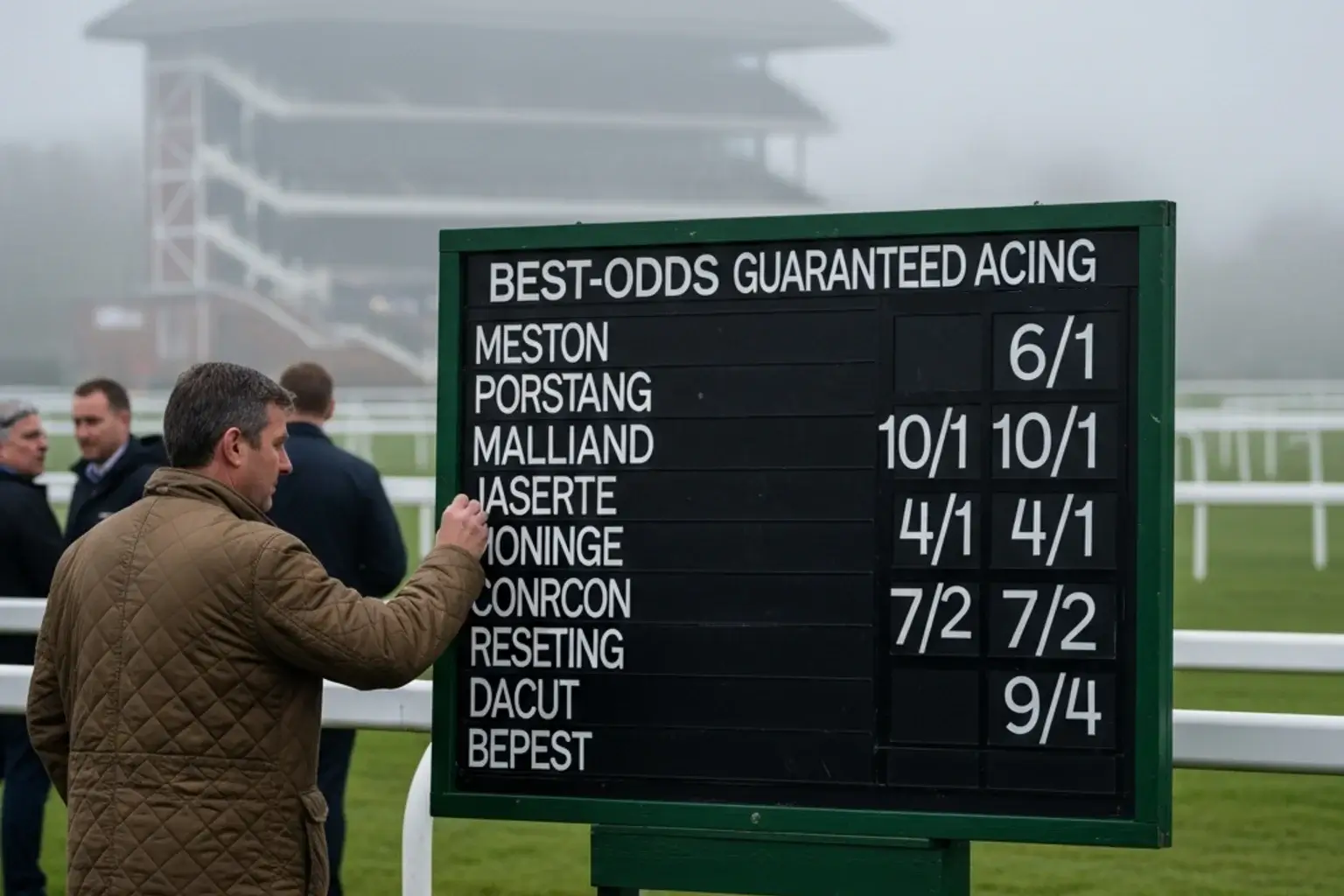
Suppose you back a horse at 6/1 in the morning. By race time, that horse drifts out to 10/1 at the off. With Best Odds Guaranteed, your bet is settled at 10/1, not 6/1. You've gained four extra points of value simply by having taken an early price with a BOG bookmaker.
The opposite scenario matters too. If your 6/1 shot is backed into 4/1 by race time, you keep 6/1. BOG removes the risk of taking early prices, which fundamentally changes how you can approach morning betting.
BOG Start Times and Limits
Not all BOG policies are equal. According to comparative research from horseracing.net, different bookmakers apply BOG from different times:
| Bookmaker | BOG Start Time | Daily Limit | Notable Exclusions |
|---|---|---|---|
| bet365 | 8:00 | Not published | SP must be returned |
| Ladbrokes | 8:00 | £2,500 | UK and Ireland only |
| Coral | 8:00 | £2,500 | UK and Ireland only |
| Sky Bet | 9:00 | £50,000 | UK and Ireland only |
| Paddy Power | 8:00 | Not published | Selected races |
| Betway | 9:00 | £10,000 | UK and Ireland only |
| BoyleSports | 8:00 | £5,000 | UK and Ireland only |
| BetVictor | 9:00 | £5,000 | UK and Ireland only |
| William Hill | N/A | N/A | No BOG offered |
The limits matter more than you might expect. According to analysis from GG.co.uk, Sky Bet's £50,000 daily limit is among the industry's most generous, while Ladbrokes and Coral restrict payouts to £2,500 per day. For most bettors, any of these limits are irrelevant. For serious punters placing significant stakes, the difference is substantial.
The William Hill Exception
Important: William Hill no longer offers Best Odds Guaranteed on horse racing. This represents a significant departure from industry standard and means bettors who take early prices risk missing out if the SP drifts. Consider this carefully before choosing William Hill for horse racing despite their other features.
William Hill's decision to withdraw BOG is notable because it removes a feature most competitors still provide. According to Racing Post analysis, this makes them an outlier among major UK bookmakers. For casual bettors who typically bet at SP, this may not matter. For anyone who takes morning prices, it's a genuine disadvantage.
bet365's Price Match Feature
bet365 operates differently. Their standard BOG applies from 8:00 on race days, like most competitors. Additionally, from 10:00 on race days, they offer to match the best price available across six named competitors (Ladbrokes, William Hill, Paddy Power, Coral, Sky Bet, and BoyleSports) on ITV Racing broadcasts. This price match feature isn't technically BOG but achieves a similar outcome: you're protected against taking a worse price than you could have got elsewhere. Combined with their standard BOG from 8:00, this makes bet365 highly competitive for televised racing.
When BOG Actually Helps
BOG is most valuable when:
- You bet early in the day, when prices are most likely to move significantly
- You back horses in competitive handicaps where market opinion shifts substantially
- You have strong views on horses that others haven't yet identified
If you typically bet in the final minutes before a race, BOG offers minimal benefit because prices have already settled near their final level. The feature rewards early conviction, which suits bettors who do morning form study and act on their conclusions.
BOG and Free Bets
Most bookmakers apply BOG to free bet stakes, which can significantly increase their value. A free bet at 4/1 that drifts to 6/1 returns 50% more profit than you initially expected. This interaction makes BOG-offering bookmakers preferable for using welcome bonuses on horse racing, even if the headline free bet amount is slightly lower than competitors without BOG support.
Each-Way Betting Explained
Each-way betting is the most distinctively British betting format, and understanding it is essential for anyone using free bets on horse racing. An each-way bet is actually two bets: one for your selection to win, and one for it to place (typically finish in the top 2, 3, or 4 depending on field size and race type).
The Basic Mechanics
When you place a £10 each-way bet, you're staking £20 total: £10 on the win and £10 on the place. If your horse wins, both bets pay out. If it places but doesn't win, you lose the win portion but collect on the place bet. If it finishes outside the places, you lose everything.
The place bet pays at a fraction of the win odds. Standard terms are:
- 1/4 odds for most non-handicap races with 5-7 runners (places 1-2)
- 1/5 odds for handicaps with 8-15 runners (places 1-3)
- 1/4 odds for handicaps with 16+ runners (places 1-4)
In practice, this means a £10 each-way bet at 10/1 (1/5 terms, paying 3 places) works as follows: if the horse wins, you collect £100 (win bet) plus £20 (place bet at 2/1) plus stakes returned, totalling £140. If it finishes 2nd or 3rd, you collect just the £20 place payout plus your £10 place stake, totalling £30.
Understanding Place Terms: The "1/5 odds" or "1/4 odds" phrase tells you how much the place portion pays relative to the win odds. At 10/1 with 1/5 terms, the place bet pays 10 ÷ 5 = 2/1. At 10/1 with 1/4 terms, it pays 10 ÷ 4 = 2.5/1. Better fractions mean better place returns.
Extra Places Promotions
Many bookmakers offer enhanced place terms on selected races, typically paying 4, 5, or even 6 places instead of the standard 3. These extra places promotions are particularly common during festivals and on competitive handicaps. They can transform each-way betting from a defensive strategy into a profitable angle.
A horse that finishes 5th in a standard race returns nothing. The same horse finishing 5th in a race with 6-place terms still collects the place portion. Over time, extra places promotions shift expected value in the bettor's favour, which is why experienced punters specifically seek out races where bookmakers are paying additional places.
When Each-Way Makes Sense
Each-way betting works best with specific profile selections:
- Horses at odds of roughly 5/1 or higher (below this, the place portion becomes less rewarding relative to the risk)
- Competitive races where multiple horses have realistic winning chances
- Selections you believe are more likely to place than their odds suggest
Each-way betting makes less sense for short-priced favourites or in small fields where place terms require finishing in the first two. A 2/1 shot in a 5-runner race offers poor each-way value because you're essentially betting on it to finish top two at unrewarding odds.
Each-way free bets are worth more than win-only free bets of the same value because they effectively give you two chances to collect. When using free bets, each-way options on horses at 8/1 or higher can maximise expected returns.
Each-Way Free Bet Considerations
When placing free bets each-way, remember that most bookmakers treat this as two separate bets. A £20 each-way free bet is actually two £10 free bets. Some welcome offers specify win-only markets, excluding each-way use. Check the terms before assuming you can split your free bet this way.
Where each-way free bets are permitted, they can be strategically advantageous. The place portion provides a safety net, and in races with extra places, your chance of collecting something rises significantly. This reduces variance compared to win-only free bets on longshots.
Free Bet & Each-Way Toolkit
Three calculators built from the formulas in this guide: free bet value, Best Odds Guaranteed, and each-way place terms. Informational only.
No-Deposit Free Bets: Are They Worth Your Time?
No-deposit free bets are the siren call of betting promotions. The promise is seductive: free money without risking anything. The reality is considerably more complicated, and in most cases, significantly less valuable than deposit-based alternatives.
How No-Deposit Offers Work
A no-deposit offer typically gives you a small free bet, usually £5-10, simply for registering an account. No payment required, no qualifying bet necessary. You sign up, verify your identity, and receive your free bet. Sounds perfect.
The catch is always in the wagering requirements. No-deposit free bets almost universally come with strict conditions on withdrawing any winnings. Common terms include:
- Winnings must be wagered 3-5 times before withdrawal
- Minimum odds of 1/1 or higher on qualifying bets
- Maximum withdrawal caps of £50-100 regardless of how much you win
- Short expiry periods requiring rapid use
These conditions dramatically reduce expected value. A £10 no-deposit free bet with 5x wagering at evens has an expected return of roughly £1.50-2, not £10. You can still get lucky and extract more, but the maths work against you.
Comparing to Deposit Offers
Consider two hypothetical offers:
No-deposit: £10 free bet, winnings subject to 5x wagering at 1/1 minimum, max withdrawal £100.
Deposit-based: Bet £10 get £30 in free bets, single turnover, no withdrawal cap.
The no-deposit offer costs you nothing but returns roughly £1.50-2 in expected value. The deposit offer requires £10 but returns approximately £21-24 in expected value (roughly 70-80% of £30). The deposit offer is clearly superior despite requiring initial capital.
Wagering Trap: High wagering requirements on no-deposit offers mean most of your winnings will be recycled through the bookmaker before you can withdraw. Each betting cycle loses you roughly 5% to the house edge, so 5x wagering burns through about 25% of your balance mathematically. Factor this into your expectations.
When No-Deposit Offers Make Sense
Despite their limitations, no-deposit offers have a place in certain situations:
- Testing a platform: If you want to experience a bookmaker's interface before committing money, a no-deposit offer lets you explore risk-free.
- Casual experimentation: For someone who wants to try betting on a specific event without any financial commitment, these offers provide an entry point.
- Stacking with deposit offers: Some bookmakers let you claim a no-deposit bonus and later claim a deposit bonus too. In this case, taking both costs nothing and adds marginal value.
The Realistic Expectation
Approach no-deposit offers as a minor bonus rather than a serious opportunity. If you're spending significant time hunting for no-deposit offers and completing their wagering requirements, your hourly return is likely below minimum wage. The time is better spent identifying and using high-quality deposit offers with cleaner terms.
That said, if a no-deposit offer lands in your inbox and requires minimal effort to claim, there's no harm in using it. Just don't mistake the £10 headline figure for £10 of actual value. The number that matters is what you can realistically withdraw, and that's almost always a fraction of what the promotion advertises.
Festival Betting Offers: Cheltenham and Grand National
If you're planning to open new betting accounts, timing matters. The two peak periods for horse racing promotional offers in Britain are the Cheltenham Festival in March and the Grand National meeting at Aintree in April. During these weeks, bookmakers compete aggressively for new customers, and the resulting offers are typically the year's most generous.
The Cheltenham Effect
Cheltenham Festival is the annual showcase for National Hunt racing, four days of championship-level competition that attracts betting activity unlike any other meeting. According to William Hill, the expected betting turnover for Cheltenham Festival 2026 is approximately £450 million. All 28 races on the Festival programme ranked among the 31 most heavily bet races of 2025.
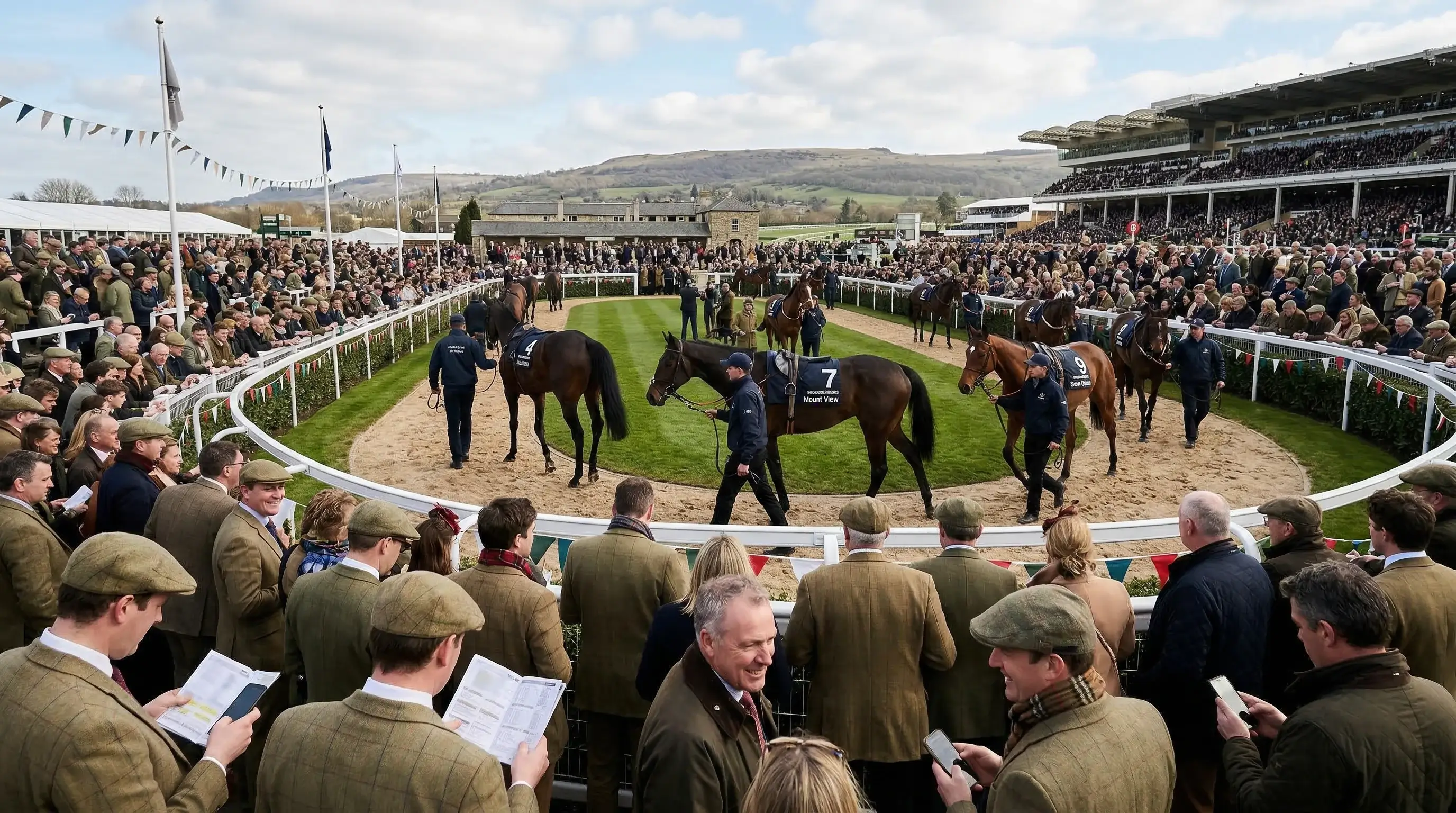
This concentrated betting activity creates intense competition among bookmakers. Research from Optimove Insights shows that new customer deposits during Cheltenham Festival week run 310-417% above normal levels. Bookmakers know that customers acquired during festivals often become long-term accounts, so they're willing to offer enhanced terms to capture them.
The practical implication: if you're considering opening accounts with multiple bookmakers, doing so in the week before Cheltenham typically yields better welcome offers than signing up at random times. Many bookmakers also run specific Festival promotions: enhanced odds on the Champion Hurdle, money-back specials if your horse finishes second to the favourite, extra places on handicaps.
According to Optimove Insights, punters placed 68.8 million bets on the 2025 Cheltenham Festival across the UK bookmakers analysed. That's roughly one bet per adult in the country, concentrated into just four days of racing.
Grand National: The Casual Punter's Event
The Grand National at Aintree attracts a different audience. While Cheltenham draws committed racing fans, the National brings millions of once-a-year bettors into the market. According to Entain research, the Grand National attracts 700% more bets than the Cheltenham Gold Cup, demonstrating its unique appeal to casual punters. Around 30% of people betting on the Grand National are placing either their first bet ever or their first bet in twelve months.
This casual participation shapes the type of offers available. Bookmakers emphasise simplicity and accessibility: straightforward free bet offers, money-back promotions if your horse falls, and low minimum stakes. The focus is on attracting new customers who might be intimidated by complex terms.
The scale is substantial. According to UK Bookmakers data, expected betting turnover on the Grand National 2025 was projected to exceed £200 million, with the full Aintree Festival generating around £250 million. These figures position the National as the single most heavily bet race of the British calendar.
"Racing also needs big names. The National Hunt scene has arguably more equine stars than the Flat. The likes of Constitution Hill and Galopin Des Champs are household names who have resonated with sports bettors. These names have certainly helped create interest in the festival." — Simon Clare, PR Director, Entain UK
Festival Offer Types
During major festivals, you'll encounter several offer categories beyond standard welcome bonuses:
- Enhanced odds: Boosted prices on specific selections, often the favourites in feature races. A horse at 5/1 elsewhere might be offered at 10/1 to new customers, with winnings paid in free bets.
- Money back specials: Refunds if your selection finishes second to the favourite, falls at the last, or loses by a narrow margin. These reduce risk on individual bets.
- Extra places: Extended place terms on festival handicaps, paying 5 or 6 places instead of the usual 3 or 4. Valuable for each-way bettors.
- Free bet reload: Additional free bets for existing customers who deposit and bet during the festival period. Less generous than welcome offers but still worth claiming.
The Casual Punter Profile
The Grand National betting data reveals something important about who participates. Entain research indicates that 82% of cash bets placed on the Grand National are £5 or less. This is overwhelmingly a recreational activity, with most participants treating it as entertainment rather than serious investment.
Understanding this helps calibrate expectations. If you're using free bets strategically during the National, you're operating in a market dominated by casual participants. That's neither good nor bad, but it shapes how prices move and which horses attract support. The market isn't necessarily more exploitable, but it does behave differently from regular racing cards.
Strategic Timing
The optimal approach for welcome offer hunters: open accounts in the days immediately before Cheltenham (typically the first week of March) and use free bets on Festival races. If you want to open additional accounts, wait until the week before the Grand National. This maximises both the offer quality and the racing quality you're betting on.
Don't feel obligated to bet on poor selections just because you have a free bet. If the Festival offers aren't appealing, many bookmakers allow free bets on any horse racing market. A free bet on a Saturday handicap at Newbury is worth the same as one on the Gold Cup.
Horse Racing Betting Apps: Mobile Experience
Mobile betting now dominates horse racing wagering. The number of physical betting shops in Great Britain fell by 106 to 5,825 in the year to March 2025, according to Gambling Commission data, while online and mobile betting continues to grow. If you're using free bets on horse racing, you're almost certainly doing it on your phone.
What Makes a Good Racing App
Horse racing places specific demands on betting apps. You need fast access to race cards, ability to view market movers, quick bet placement, and ideally live streaming. The essential features:
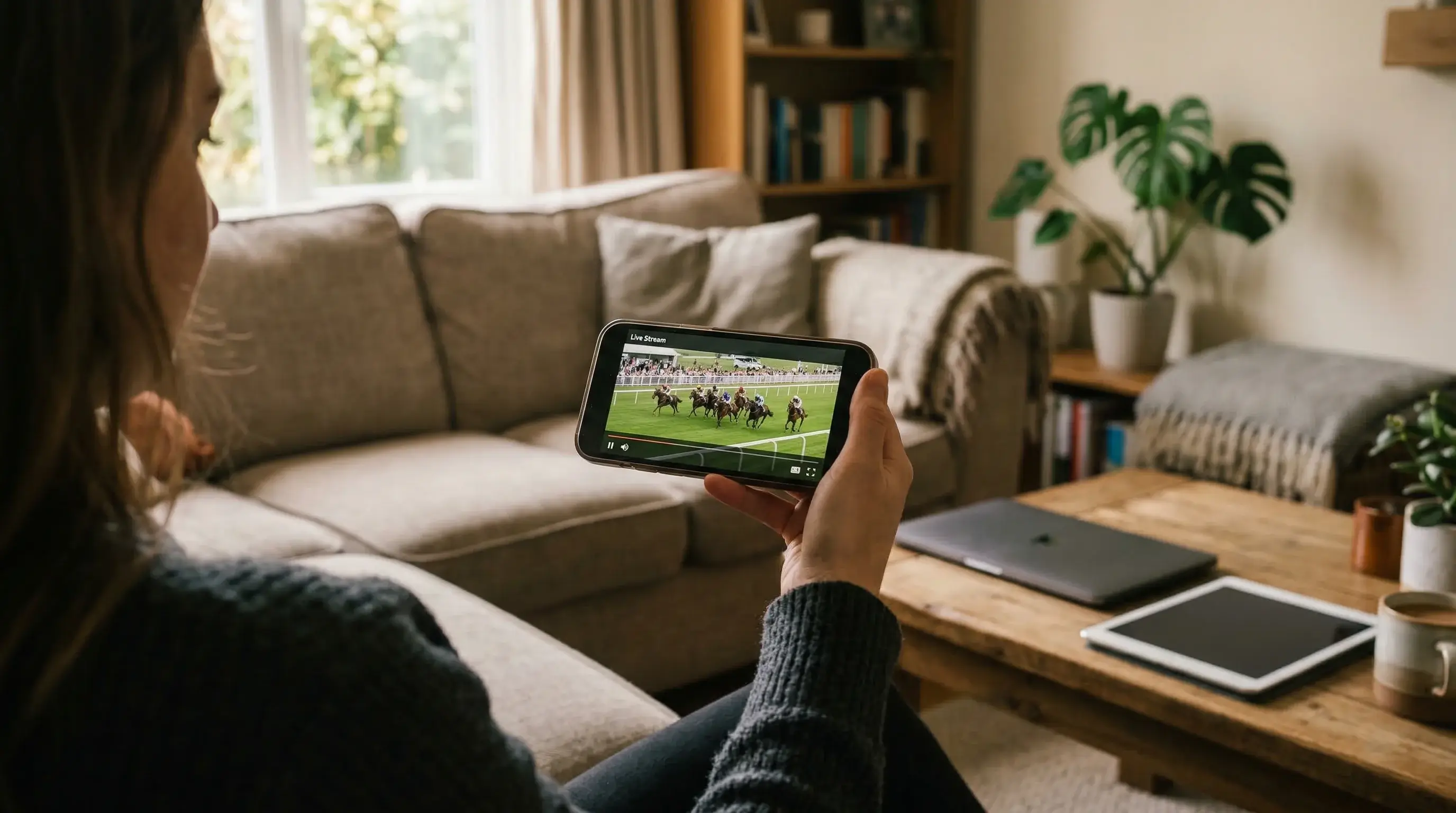
- Live streaming: Watch races directly in the app, typically requiring a funded account or recent bet.
- Race card integration: Full race cards with form, jockey and trainer stats without switching to external sources.
- Quick bet: Pre-set stake buttons and streamlined bet placement for moving markets.
- Cash out: Ability to close positions before races finish.
App Comparison for Horse Racing
| App | Streaming | Race Card Quality | Notable Features |
|---|---|---|---|
| bet365 | Excellent | Comprehensive | ITV Racing price match, extensive coverage |
| Sky Bet | Sky Sports Racing | Good | Request a Bet, high BOG limits |
| Paddy Power | Good | Good | Money back promotions |
| Betfair | Good | Excellent | Exchange integration, price charts |
| Ladbrokes | Good | Good | Grid card, established interface |
Live Streaming and Mobile Features
Most bookmaker apps offer live racing streams, but access conditions vary. bet365 requires a funded account; others require a bet placed in the last 24 hours. Stream quality has improved significantly, with major bookmakers now offering reliable HD streams with minimal delay.
Some bookmakers offer mobile-exclusive features. Sky Bet's Request a Bet function works smoothly via app. Betfair's exchange trading is fully functional on mobile with effective price charts. Push notifications can alert you to price changes and promotions, though most apps let you customise these to avoid spam.
Claiming Welcome Offers on Mobile
All major bookmakers allow you to claim welcome offers via their apps. The process is identical to desktop: download, register, deposit, and place your qualifying bet. Keep email and SMS notifications enabled during sign-up and for a few days afterward, as bookmakers send free bet confirmations via these channels.
Free Bet Strategy: Maximising Your Expected Value
Most people use free bets the same way they'd use their own money: back a horse they fancy and hope it wins. This isn't wrong, but it's not optimal. Free bets have specific characteristics that reward different approaches than regular cash betting.
Understanding Expected Value
A free bet with stake not returned has an expected value (EV) of roughly 70-80% of its face value when used on selections at typical odds. The exact percentage depends on the odds: longer shots extract more value because the stake component you're "losing" is proportionally smaller. A £10 free bet at 2/1 has roughly 67% EV, at 5/1 roughly 83%, and at 10/1 roughly 91%.
This mathematics suggests using free bets on longer-priced selections when you can. However, betting on 10/1 shots isn't profitable long-term regardless of whether you're using free bets or cash. The optimal approach balances these considerations.
The Matched Betting Angle
Matched betting is a legal technique that uses betting exchanges to lock in profit from free bets regardless of the outcome. Place your free bet on a selection at a bookmaker, then lay the same selection at an exchange. Whatever happens, one side wins and one side loses, but the free bet component generates net profit.
Conversion Rates: Well-executed matched betting typically converts 75-85% of a free bet's face value into guaranteed cash profit. A £30 free bet becomes £22-25 extractable profit. This requires access to a betting exchange like Betfair Exchange or Smarkets, but the process is straightforward once understood.
Matched betting isn't gambling. Outcomes don't affect your profit because you've covered both possibilities. The catch is it requires time, attention to detail, and eventually bookmakers may restrict your account if they identify you as a pure bonus abuser.
Value Distribution in Horse Racing
Research from the National Centre for Social Research, cited in Racing Post analysis, found that the top 1% of horse racing bettors generate 52% of all bookmaker revenue. The recreational majority lose money over time. Free bets don't change this fundamental dynamic, but they reduce the cost of learning.
Strategic Principles
Whether or not you pursue matched betting, certain principles maximise free bet value:
- Use them on races you'd bet anyway: Don't force bets on unfamiliar meetings just to use a free bet.
- Consider each-way on bigger fields: A free bet each-way at 8/1 with extra places gives multiple ways to collect.
- Don't let them expire: Even a random pick at 5/1 is worth more than an expired free bet.
- Stack with BOG: Use free bets at bookmakers offering Best Odds Guaranteed for additional upside.
Free bets are marketing expenses for bookmakers, designed to acquire customers who will lose money over time. Using them strategically reverses this dynamic. The bookmaker expects to profit from giving you free bets; your job is to prove them wrong.
The Long-Term Perspective
Free bets from welcome offers are finite. Once you've claimed offers from all major bookmakers, the supply largely ends. Use the welcome offer period to learn: experiment with different bet types, track results, develop form analysis skills. The free bets subsidise this education. By the time they're exhausted, you should understand whether horse racing betting is something you can do profitably or purely entertainment that costs money over time.
Frequently Asked Questions
How do horse racing free bets work in the UK?
Horse racing free bets are promotional tokens issued by bookmakers that let you place wagers without using your own money. Most require a qualifying bet first: typically, you deposit and bet a specified amount at minimum odds, and the bookmaker then credits free bets to your account. When you win a free bet, you receive the profit but not the stake (known as "stake not returned"). For example, a winning £10 free bet at 4/1 returns £40 profit rather than £50. Free bets usually expire within 7 days and may be restricted to certain markets or bet types. Always check the terms and conditions before claiming any offer.
What is Best Odds Guaranteed and why does it matter?
Best Odds Guaranteed (BOG) is a feature where bookmakers pay you at whichever price is higher: the odds you took or the starting price (SP) when the race begins. If you back a horse at 6/1 in the morning and it drifts to 10/1 by race time, you're paid at 10/1. This removes the risk of taking early prices and is valuable for anyone who bets before race time. Most major bookmakers offer BOG, but limits and start times vary. Sky Bet offers BOG from 9:00 with a £50,000 daily limit, while Ladbrokes and Coral start at 8:00 but limit payouts to £2,500 per day. Notably, William Hill no longer offers BOG, which is significant for regular horse racing bettors.
Can I actually make money from free bets?
Yes, free bets can generate real profit. The most reliable method is matched betting, a legal technique that uses betting exchanges to guarantee profit regardless of race outcomes. By placing a free bet at a bookmaker and laying the same selection at an exchange, you lock in a return of roughly 75-85% of the free bet's face value. A £30 free bet can reliably produce £22-25 in extractable cash. Without matched betting, free bets are still valuable but outcomes depend on results. Over time, bookmakers profit from most customers, but strategic use of free bets, particularly during the welcome offer phase, can be genuinely profitable. The key is understanding that free bets have calculable expected value and treating them accordingly.
Responsible Gambling: Tools and Support
Free bets and promotions are designed to attract and retain customers. The business model only works if many customers bet beyond their welcome offers and lose money over time. Understanding this reality is essential for anyone using betting promotions.
The Scale of Problem Gambling
Problem gambling affects a significant minority of UK bettors. According to the Gambling Commission's Gambling Survey for Great Britain 2024, 2.7% of adults qualify as problem gamblers based on PGSI scores of 8 or above. The figure is higher among younger bettors: 10.2% of gamblers aged 18-24 fall into this category. The Office for Health Improvement and Disparities estimates 1.76 million people in England experience some level of gambling-related harm.
"The Grand National is one of the precious few sporting events in this country with the ability to unite the entire nation around a single spectacle. It is the nation's punt, and it is being subverted by illegal operators offering illicit gambling to thousands of punters, many of whom are vulnerable to harm." — Grainne Hurst, CEO, Betting and Gaming Council
Warning Signs and Available Tools
Problem gambling develops gradually. Warning signs include betting more than you can afford, chasing losses, lying about betting activity, borrowing money to bet, and feeling restless when not betting. If these descriptions feel familiar, consider whether your relationship with betting has become unhealthy.
All UK-licensed bookmakers offer responsible gambling tools: deposit limits, loss limits, session time limits, reality checks, and self-exclusion. GAMSTOP provides a national self-exclusion scheme covering all UK-licensed operators for 6 months, 1 year, or 5 years.
Support Resources: If you're struggling with gambling, help is available. The GambleAware website provides information and support. The National Gambling Helpline can be reached on 0808 8020 133, available 24 hours a day, 7 days a week.

Betting Within Your Means
The fundamental principle: only bet what you can afford to lose. Ask yourself: if every bet you place today loses, would that cause financial stress? If yes, you're betting too much. Free bets can create a sense of reduced risk, but free bet winnings are real money and habits formed during welcome offer periods persist afterward. For most participants, the expected outcome is net losses offset by enjoyment. That's fine if the cost is affordable. It's problematic when betting exceeds what you can sustain.
